St. Nicholas Day · December 6
St. Nicholas Weckmann bread men
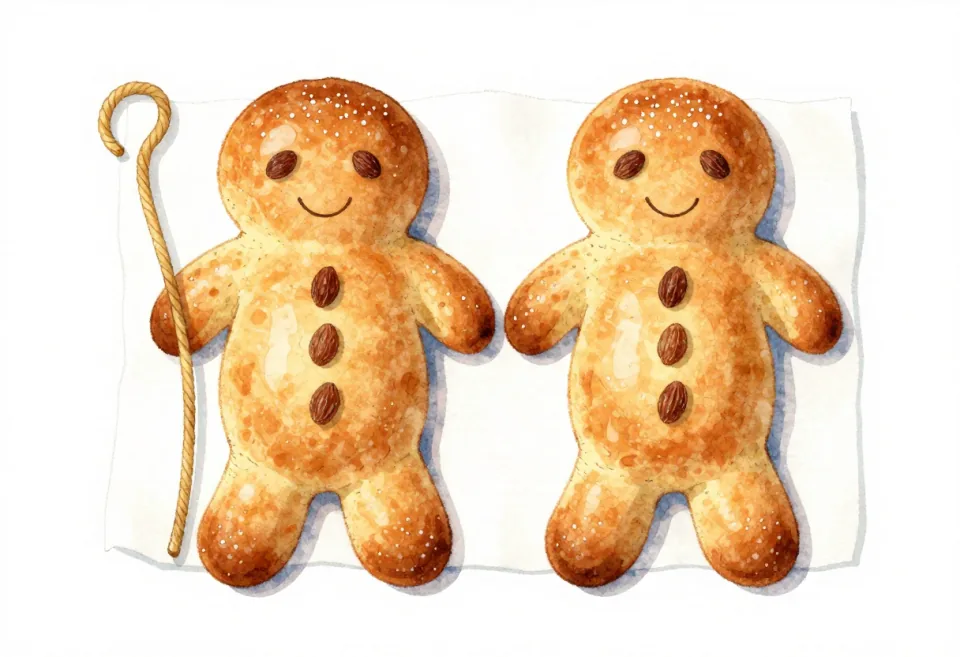
Weckmänner, also called Stutenkerle, are soft, sweet yeast-bread men with raisin eyes and buttons that German bakeries and families make for St. Nicholas Day, December 6. This recipe makes 6 bread men, each holding a bishop’s crozier; plan about 2½ hours, most of it rising time.
- Prep
- 35 min
- Cook
- 18 min
- Rise
- 1 hr 30 min
- Total
- 2 hr 23 min
- Makes
- 6 bread men
- Level
- Medium
Adult supervision required. Grown-ups handle the oven, stovetop, knives, and anything hot.
Contains: wheat (gluten), milk, egg. Full allergy notes
Printable recipe card: US Letter PDF · A4 PDF
Why we make this for St. Nicholas Day
In the Rhineland, bakery windows fill with Weckmänner in late autumn: sweet bread men with raisin eyes and buttons. Weck is a regional word for a bread roll. In Westphalia the same little man is called a Stutenkerl, “sweet-bread fellow,” and in Switzerland a Grittibänz. Children get them around St. Martin’s Day, November 11, and on St. Nicholas Day, December 6.
Many families say the bread man is St. Nicholas himself, the kind bishop of Myra. Weckmänner often hold a small white clay pipe, and many people say it was once a bishop’s crozier turned upside down, though no one knows for sure. In this recipe, each bread man gets a crozier of his own, made from dough.
A crozier is the curved staff a bishop carries. It is shaped like a shepherd’s crook because a bishop cares for his people the way a shepherd cares for his sheep, following Jesus, who said, “I am the good shepherd” (John 10:11). St. Nicholas cared for the poor of Myra so well that families still tell his stories and keep his feast more than 1,600 years later.
St. Nicholas Day · December 6
St. Nicholas Weckmann bread men
- Prep 35 min
- Cook 18 min
- Rise 1 hr 30 min
- Total 2 hr 23 min
- Makes 6 bread men
- Level Medium
Adult supervision required
Cooking is for children and grown-ups together. An adult should supervise at all times and handle the oven, stovetop, knives, and anything hot. A grown-up snips the arms and legs with kitchen scissors and moves the hot baking sheets. Raisins are a choking hazard for children under 4, so pick them out or cut the bread small. If you add a clay pipe from a bakery, it is a decoration only: take it out before a child eats the bread.
Allergy information
Contains wheat (gluten), milk, and egg. Always read ingredient labels, since brands vary, and ask about food allergies before you cook or share.
Ingredients
- 4 cups (500 g) all-purpose flour, plus more for kneading
- 2¼ tsp (1 packet, 7 g) instant yeast
- ⅓ cup (65 g) sugar
- 1 tsp salt
- Finely grated zest of 1 lemon (optional)
- 1 cup (240 ml) lukewarm milk
- 1 large egg
- 5 tbsp (70 g) butter, softened
To decorate
- 1 egg yolk beaten with 1 tbsp milk
- About 3 tbsp raisins or currants, for eyes and buttons
- Pearl sugar or coarse sugar (optional)
Method
- Mix the flour, yeast, sugar, salt, and lemon zest in a large bowl. Add the lukewarm milk (warm to the touch, about 105°F/40°C) and the egg and mix to a shaggy dough. Add the soft butter and knead for 8 to 10 minutes, by hand or with a dough hook, until smooth, soft, and springy.
- Cover the bowl and let the dough rise in a warm place for about 1 hour, until doubled.
- Line two baking sheets with parchment paper. Pinch off a walnut-size piece of dough for the croziers and keep it covered. Divide the rest into 6 equal pieces.
- Roll each piece into a smooth log about 6 inches (15 cm) long and press it flat, about ¾ inch (2 cm) thick. Pinch in a neck about a third of the way down to make the head. A grown-up snips a slit on each side below the neck for arms and one up from the bottom for legs, then spreads them apart a little.
- Roll the reserved dough into 6 thin ropes. Curl the top of each into a shepherd’s crook and lay it along one arm, folding the hand over it. Press raisins deep into the dough for 2 eyes and 3 buttons, so they do not pop out in the oven.
- Cover loosely and let rise 20 to 30 minutes, until puffy, while the oven heats to 350°F (175°C). Brush with the egg wash and sprinkle with pearl sugar if you like.
- Bake 15 to 20 minutes, until deep golden brown and the bottoms sound hollow when tapped. Cool on a rack.
Little helpers can (with a grown-up)
- Knead the dough and feel it turn smooth
- Press in the raisin eyes and buttons
- Roll a thin rope and curl it into a crozier
- Brush on the shiny egg wash
Good to know
- Make the dough the night before: after kneading, cover and refrigerate it overnight, then shape it cold and allow about 45 minutes for the second rise.
- Weckmänner are best the day they are baked. The next day, warm them in the oven for a few minutes, or split and toast them and spread with butter and jam.
A blessing before we eat
Bless us, O Lord, and these thy gifts, which we are about to receive from thy bounty, through Christ our Lord. Amen. Saint Nicholas, pray for us, and help us care for others the way a good shepherd cares for his flock.
Christian Goodnight · christiangoodnight.com/recipes/st-nicholas-weckmann · Bedtime stories for every feast in the free Woly app
Made it? Tell other families how it went.
Four quick taps, no typing. Your answers help other families choose what to make.
Questions families ask
What is a Weckmann?
A Weckmann is a sweet yeast bread shaped like a little man, with raisin eyes and buttons, sold in German bakeries for St. Martin’s Day and St. Nicholas Day. Many families say the figure is St. Nicholas himself.
Why does the Weckmann have a pipe?
No one knows for sure. A common explanation is that the little clay pipe was once a bishop’s crozier, the shepherd’s staff St. Nicholas carries, turned upside down. A dough crozier, a pretzel stick, or a paper crozier tucked under his arm is a good swap.
What is the difference between a Weckmann and a Stutenkerl?
They are the same sweet bread man with different regional names: Weckmann in the Rhineland, Stutenkerl in Westphalia, and Grittibänz in Switzerland.