Christian Goodnight
Get the app
All Hallows’ Eve · History & activities
Where does Halloween come from?
Halloween is short for All Hallows’ Eve, the evening before All Saints’ Day. Here is how a Christian feast, old harvest customs, and a few glowing turnips became the night we know, with printable activities to share with your children.
In short
- Halloween means “holy evening.” It is short for All Hallows’ Eve, the night before All Saints’ Day on November 1.
- The name and date are Christian. All Saints’ Day has been kept on November 1 since the 700s and 800s, and All Souls’ Day follows on November 2.
- Many customs grew over time. Souling for soul cakes, Scottish and Irish guising, and carved turnip lanterns all fed into today’s trick-or-treating and jack-o’-lanterns.
What’s in a name?
“Hallow” is an old word for a holy one, a saint.
Long ago, November 1 was called All Hallows’ Day, the feast of all the saints. The night before was All Hallows’ Even, the evening of getting ready. Said quickly for a few hundred years, it became Hallowe’en. The apostrophe in the old spelling marks the missing letters of “even.”
You already know the word: we say it every time we pray, “Our Father, who art in heaven, hallowed be thy name.”
Hallowtide
Three days, one story.
Together these days are called Hallowtide. They move from getting ready, to celebrating the saints, to praying for those we love.
-
October 31
All Hallows’ Eve
The vigil: an evening of getting ready for the great feast the next day.
-
November 1
All Saints’ Day
A celebration of all God’s friends in heaven, the famous saints and the many whose names only God knows.
-
November 2
All Souls’ Day
A day to pray for loved ones who have died and to remember them with love.
Through the centuries
How All Hallows’ Eve became Halloween.
-
Before Christianity reached them
A harvest festival in Ireland and Scotland
Gaelic peoples marked Samhain around November 1, at the end of the harvest and the start of winter. Historians still discuss how many later Halloween customs came from Samhain and how many grew out of Christian Hallowtide.
-
About 609
A church for all the martyrs
Pope Boniface IV dedicated the Pantheon in Rome, once a temple to many gods, as a church in honor of Mary and all the martyrs.
-
700s and 800s
All Saints’ Day comes to November 1
Pope Gregory III dedicated a chapel in St. Peter’s Basilica to all the saints. By the 800s, All Saints’ Day was kept on November 1 across much of Western Europe, and the evening before became All Hallows’ Eve.
-
Around the year 1000
All Souls’ Day
Saint Odilo, abbot of the monastery of Cluny in France, set aside November 2 for his monks to pray for all the faithful departed. The custom spread through the whole Church.
-
Late Middle Ages
Souling and soul cakes
In England and nearby lands, poor people, and later children, went door to door at Hallowtide. They offered to pray for each household’s loved ones who had died, and were given small spiced “soul cakes,” often marked with a cross. Many people see this as one root of trick-or-treating.
-
1700s
The name “Hallowe’en”
The Scottish shortening “Hallowe’en” appeared in print, and Robert Burns’s 1785 poem Halloween helped make the name famous.
-
1800s
From turnips to pumpkins
In Ireland and Scotland, people carved lanterns from turnips and other root vegetables. Irish and Scottish families who moved to North America brought their Halloween customs with them, and big, easy-to-carve pumpkins became the jack-o’-lantern.
-
Late 1800s and 1900s
Guising and trick-or-treat
Scottish and Irish children went “guising,” dressing up and visiting neighbors to offer a song, a poem, or a joke in return for a treat. In North America, the phrase “trick or treat” appeared in print in the 1920s and spread widely by the mid-1900s.
-
Today
Saints, costumes, and candlelight
Many parishes and families hold All Saints’ parties where children dress as their favorite saints. On All Souls’ Day, families still light candles and pray for the people they miss.
About this history: dates for the earliest feasts vary a little between sources, and historians still debate some of Halloween’s folk origins. We have kept to the widely accepted outline.
For the grown-ups
Is Halloween a Christian holiday?
Its name and its date come from the Christian feast of All Saints. Over the centuries it also gathered folk customs, and today families celebrate it in many different ways, or choose not to. Wherever your family lands, Hallowtide is a lovely chance to talk about the saints, to pray for those who have died, and to remember that Jesus is the light no darkness can overcome (John 1:5).
Quick questions
Halloween questions families ask.
What does Halloween mean?
Halloween is a shortened form of All Hallows’ Even, the evening before All Hallows’ Day (All Saints’ Day) on November 1. “Hallow” is an old English word for a holy person, a saint.
Is Halloween a Christian holiday?
Its name and date come from the Christian feast of All Saints, and the evening before was kept as a vigil. Over the centuries it also gathered folk customs, and today it is celebrated in many different ways.
What is the difference between All Saints’ Day and All Souls’ Day?
All Saints’ Day, November 1, celebrates everyone in heaven, famous saints and unknown ones. All Souls’ Day, November 2, is a day to pray for all who have died.
Where did trick-or-treating come from?
It has several roots: medieval “souling,” when people went door to door offering prayers for the dead in return for soul cakes, and Scottish and Irish “guising,” when costumed children performed for treats. The phrase “trick or treat” appeared in North America in the 1920s.
Why do we carve pumpkins at Halloween?
In Ireland and Scotland, people carved lanterns from turnips and other root vegetables. Irish and Scottish families who moved to North America in the 1800s used pumpkins instead, which are bigger and easier to carve.
What is Hallowtide?
Hallowtide (or Allhallowtide) is the three days of October 31, November 1, and November 2: All Hallows’ Eve, All Saints’ Day, and All Souls’ Day.
Free printables
Hallowtide activities for children.
Two coloring pages and two puzzles that tell the story of All Hallows’ Eve. Each prints on one Letter or A4 page.
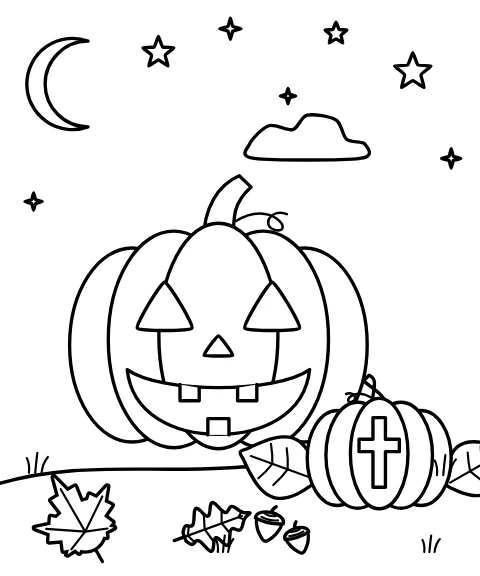
Let your light shine jack-o’-lantern
A smiling jack-o’-lantern and a little pumpkin carved with a cross.
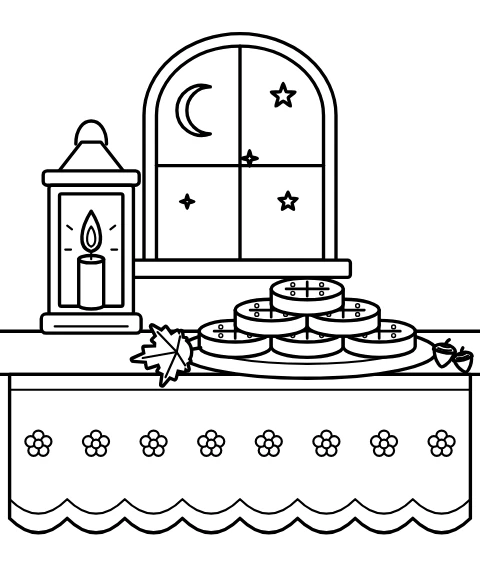
Choose this sheet: Let your light shine jack-o’-lanternSoul cakes by lantern light
Cross-marked soul cakes and a glowing lantern for All Souls’ Day.
Choose this sheet: Soul cakes by lantern light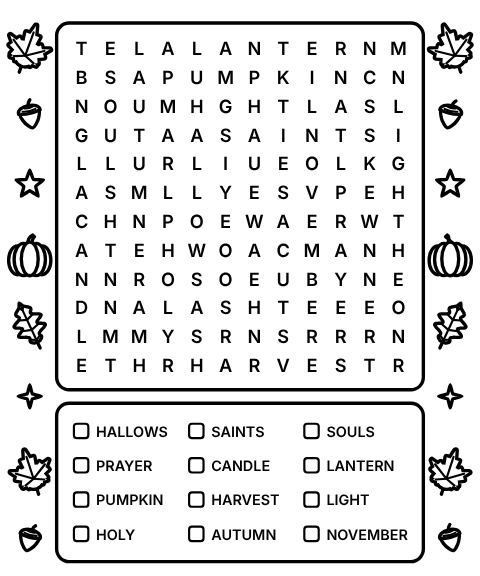
All Hallows’ Eve word search
Find 12 words from this story, from HALLOWS to NOVEMBER. Answer key included.
Choose this sheet: All Hallows’ Eve word search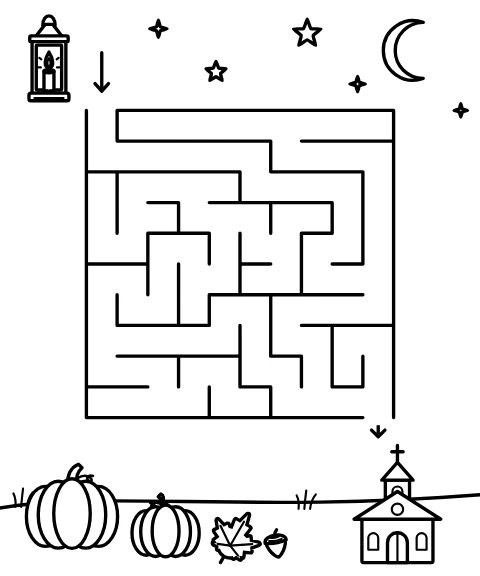
Lantern maze to the All Saints’ chapel
Guide the little lantern through the maze to the chapel. Answer key included.
Choose this sheet: Lantern maze to the All Saints’ chapelBeyond the printables
More ways to keep Hallowtide at home.
- Dress up as a saint. Choose a favorite saint, or the saint you are named after, and make a simple costume from things you already have.
- Bake soul cakes together. With a grown-up in charge of the oven, bake a batch to share with neighbors or friends, and say a prayer for their loved ones as the old “soulers” did.
- Carve or paint a pumpkin with a cross, a star, or a heart. Grown-ups do the carving and the lighting (a battery candle is safest), then pray together, “Jesus, you are the Light of the World.”
- Remember the people you miss. On All Souls’ Day, have a grown-up light a candle, look at old photos together, or visit a cemetery to pray.
- Read a saint story at bedtime. The Christian Goodnight app has an All Saints & Holyween collection of gentle bedtime stories about the saints and All Souls’ Day.
More feast day recipes are coming up: St. Nicholas cookies, St. Lucy buns, and the whole feast day calendar.